
Once your manuscript is typeset, KOBAYASHI SYOJI applies for the ISBN on your behalf and arranges printing and publication.
- We can list the finished book on Amazon; you can follow sales online.
- We deposit copies with the National Diet Library, as Japanese law requires.
- We report sales once a year and pay the agreed royalty (about 10% of the list price).
You set the list price; we handle online sales and stock. For details, contact Hayashi (llj@jpxcn.com).
ISBN basics
1. What an ISBN actually is
The ISBN (International Standard Book Number) is a 13-digit number used worldwide to identify a specific book — in effect, its passport. A new edition or a different binding gets a new number, and no two books share one. It is the string of digits printed under the barcode on the back cover.
The structure first: 978 means “this is a book”, and 4 is the registration group for Japan (Japanese). The next two blocks are the publisher element and the title element, whose lengths vary with the size of the publisher. The final digit is a check digit that guards against scanning errors. That is why the Japanese and Chinese editions of one work always carry different ISBNs — they are different books.
2. What an ISBN does
It is not decoration; it is the single key that runs through the whole distribution chain.
- Bookshops and online bookshops: ordering, stock and checkout (POS scanning) all run on the ISBN. Without one, a shop will not normally stock the book.
- Libraries: acquisition, cataloguing and catalogue search all key off the ISBN.
- E-commerce and bibliographic databases: product search on Amazon and similar platforms, title matching on review sites.
- Trade and promotion: ordering, returns and sales reporting between publishers and distributors.
If you are printing a few copies for family and friends, or distributing a zine or a non-commercial edition, you do not need an ISBN — and such copies may not carry the book JAN barcode either. To reach bookshops, libraries or online stores, it is essential.
3. Is a Japanese ISBN valid in China and elsewhere?
Yes. The ISBN is an international standard (ISO 2108). National and regional agencies allocate the numbers, but a number is valid worldwide; you never re-apply because the book crosses a border. An ISBN issued to a Japanese publisher can be used directly in library catalogues in China or the United States, on Amazon and other online bookshops, and in bookshop ordering systems.
Two different things should not be confused, though: a valid number does not mean automatic distribution. Selling through bookshops in mainland China still requires an import channel for books (licensed importers, customs clearance). That is a distribution matter; the ISBN itself needs no change.
4. Why Japanese books carry two barcodes on the back
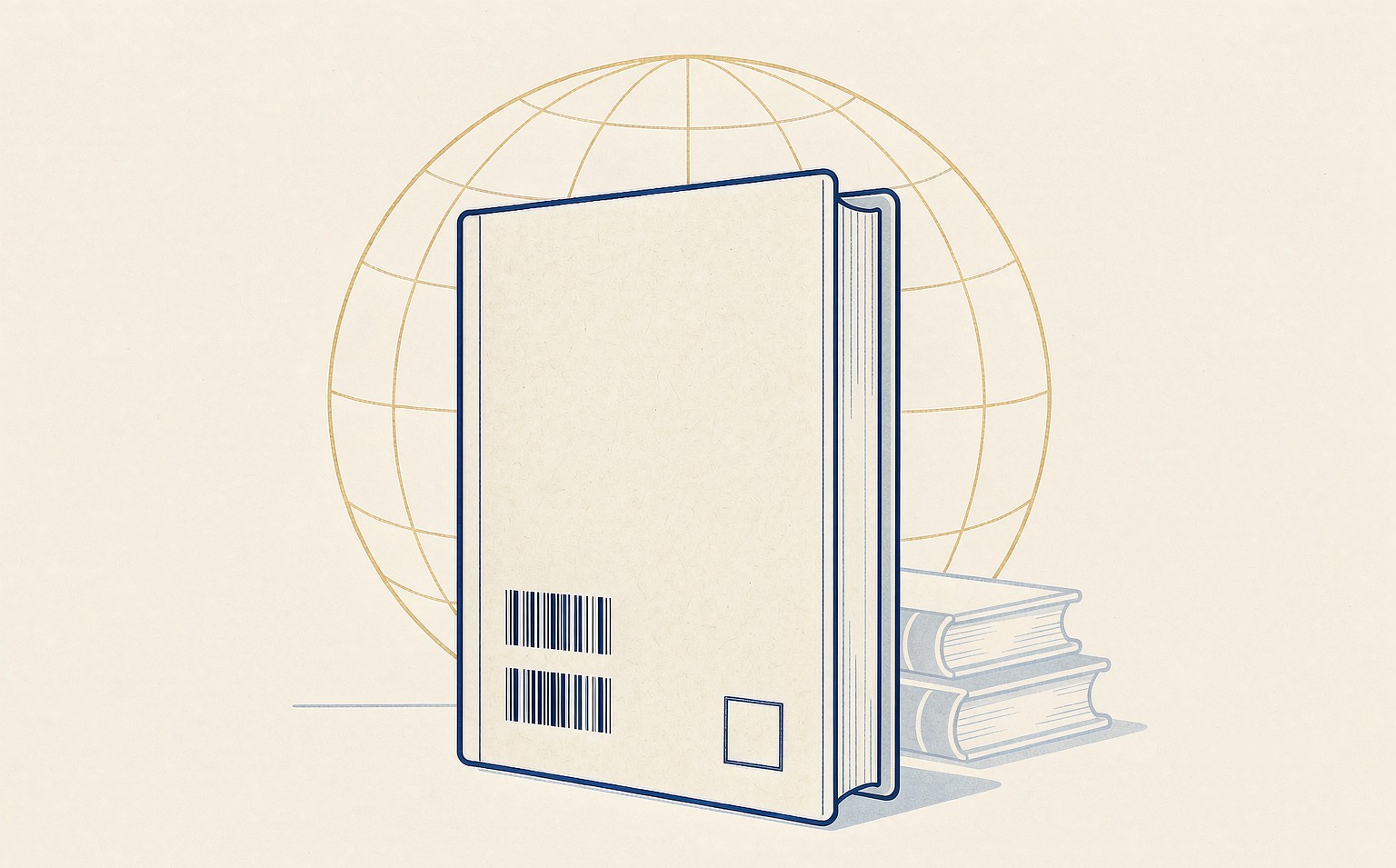
Japanese books are printed with two connected barcode tiers at the lower left of the back cover. Together they form the book JAN code. They are not duplicates but a division of labour.

The top tier is the international code (starts with 978) and works worldwide; the bottom tier is the price code (starts with 192), used only by Japanese tills and sales statistics. The second tier was added in 1991 so that convenience stores and bookshops could scan books at POS. Scanning both at once yields the title and the price. Note that non-commercial and free copies may not carry this barcode.
5. Cost and lead time for an ISBN through a Japanese publisher
ISBNs in Japan are issued by the Japan Book Code Management Center. An individual can also apply directly as a publisher. Fees after the July 2024 revision are as follows (tax included); allow about two weeks:
| Quantity | Registration fee (incl. tax) | Lead time |
|---|---|---|
| 1 copy | ¥12,100 (about US$76) | 2 weeks |
| 10 copies | ¥24,200 (about US$152) | 2 weeks |
| 100 copies | ¥44,352 (about US$279) | 2 weeks |
The publisher element is 8, 7 or 6 digits respectively; the shorter it is, the more numbers you may allocate at once. The book JAN code (barcode usage right) is a separate application: ¥11,000 (about US$69; three years for publishers with annual sales under ¥100 million). The barcode artwork must be produced by you or commissioned. Dollar amounts are indicative, at roughly ¥159 to the dollar.
Going through a publisher is far simpler: the ISBN application, the JAN barcode artwork, legal deposit with the National Diet Library and distribution to bookshops and online stores are all handled for you, and the cost is included in the publishing plan. Registration is in the publisher’s name, so the author’s personal details are not made public.