
Making a book means learning the language of paper, printing and binding. This page sets out the terms, papers, book structure, formats and text directions used in Japanese book production, with diagrams, so that authors working from abroad can follow every step of the conversation.
Our standard specification is A5, horizontal setting, perfect-bound paperback — but format, paper, binding method and text direction are always settled together with the author. We propose the combination that suits the kind of manuscript you have written: a scholarly monograph, a collection of plates, a children’s book, or a book in a language other than Japanese.
1. Basic printing and binding terms
These are the words that come up in every exchange. Using them when you mark up a proof will make the discussion much faster.
Printing and data
| Term | Meaning |
|---|---|
| Trim size | The final dimensions of the book after trimming, e.g. “A5 (148 × 210 mm)”. |
| Bleed | A margin of 3 mm beyond the trim line. It keeps a white sliver from appearing if the cut shifts slightly. Backgrounds and photographs must always extend to the bleed. |
| Trim marks crop marks | Cross marks outside the four corners of the trim line that show where to cut. A printer cannot accept a file without bleed and trim marks. |
| Resolution dpi | How finely an image is sampled, in dots per inch. For print, photographs and halftones want 350 dpi; line art 600–1,200 dpi. An image that looks sharp on screen will still print soft if the resolution is low. |
| CMYK and RGB | CMYK is the four-colour printing model (cyan, magenta, yellow, black); RGB is the additive model of screens. RGB files shift in colour when printed — vivid blues, greens and oranges most of all. Please convert artwork to CMYK. |
| Spot colour | An ink mixed for a colour that four-colour process cannot reach: gold, silver, fluorescent, a corporate colour. It needs its own plate, so it costs more than ordinary CMYK printing. |
| Trimming | Cutting the printed sheets to the trim line. Head, tail and fore edge are all cut, hence “three-side trim”. |
| Offset lithography | Ink is transferred from plate to blanket to paper. The unit cost falls as the run rises, and colour stays stable. This is how our books are normally printed. |
| Print on demand POD | Digital printing without plates. Suited to short runs and tight schedules; beyond a certain quantity it becomes dearer than offset. |
| Proofs and corrections | The final approval of a proof is “pass for press”; instructions written on the proof are “corrections”. Mark the place and the exact change, in red. |
Structure and binding
| Term | Meaning |
|---|---|
| Format | The standard size of a book: A5, Shiroku, B5 and so on. See section 4. |
| Hardcover case binding | The text block is sewn, then cased into a rigid board cover with endpapers and a headband. Durable and formal; suited to scholarly books, commemorative and limited editions. |
| Paperback | A paper cover used as it is. Light and inexpensive; most trade and practical books are made this way. |
| Perfect binding | The gathered sections are glued at the spine and the cover is wrapped around. The commonest paperback method, and stable even at length. |
| Saddle stitching | Folded sheets nested and wired through the centre fold. Good for thin booklets up to about 48 pages; thicker and the fore edge steps. |
| Spine width | The thickness of the spine, set by the page count and the thickness of the paper (formula in section 4). Needed in order to build the cover artwork. |
| ISBN | The 13-digit identifier for a book, required for sale through bookshops and libraries. We can obtain one on your behalf. |
| Colophon okuzuke | The page at the back giving title, author, publisher, date of publication, ISBN and price. Every Japanese book carries one. |
2. Papers and how to choose them
Paper divides into text paper and cover paper. The same manuscript feels like a different book when the paper changes: its weight, its presence, the ease of reading. The principle is simple — choose text paper for legibility, cover paper for the feel in the hand.
| Paper | Character | Suited to |
|---|---|---|
| Woodfree joshitsu-shi | Smooth, easy to write on with pencil or pen; the standard text paper. Some stocks carry a faint cream tone. | Scholarly books, novels, essays |
| Art paper coated | Coated and glossy. Photographs and plates reproduce vividly, with fine detail; reflections are stronger. | Photography, art books, catalogues |
| Matt art paper | Coated, but with the sheen knocked back. Quieter colour, comfortable over long reading, a sense of quality. | Collections, scholarly books, commemorative volumes |
| Lightweight coated | Lighter for the same bulk — for keeping long books thin and easy to hold. | Conference volumes, dictionaries, long books |
| Speciality paper | Coloured, textured or patterned. Poor for text, but on a cover or endpaper it changes the whole character of the book. | Covers and endpapers of limited and commemorative editions |
Paper weight is given as ream weight (kg): the weight of 1,000 sheets in the Shiroku size (788 × 1,091 mm). The larger the number, the thicker the sheet. Text papers run from 70 to 90 kg, cover papers around 180–220 kg. Two papers of the same 70 kg can still differ in caliper and handle.
* A hardcover carries an endpaper pasted inside the cover. White is perfectly acceptable; a coloured stock makes the join between text and cover far more handsome. The grain direction of the sheet (long grain or short grain) affects how it folds and binds, so text paper is ordered long grain as a rule.
3. The parts of a book (diagrams)
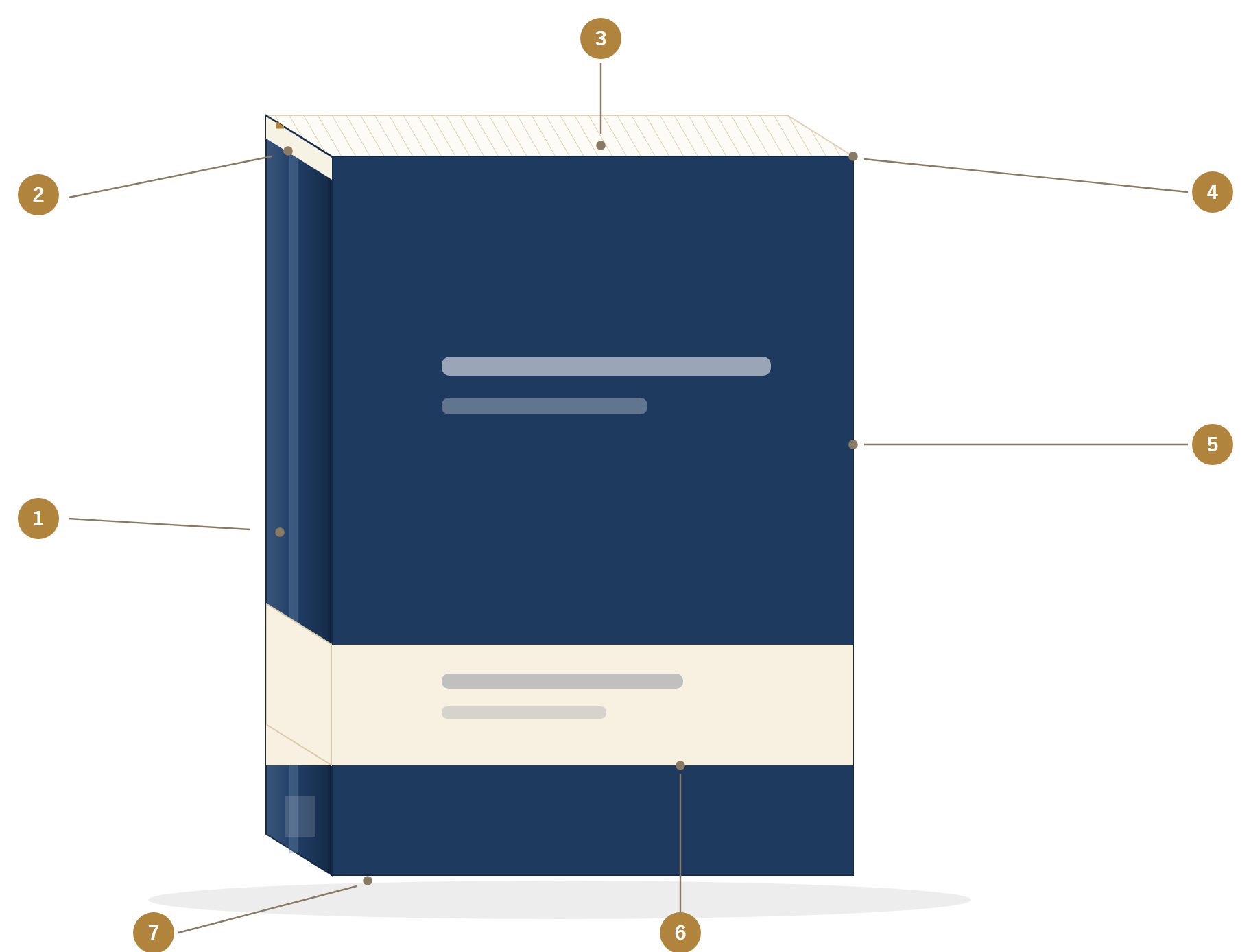
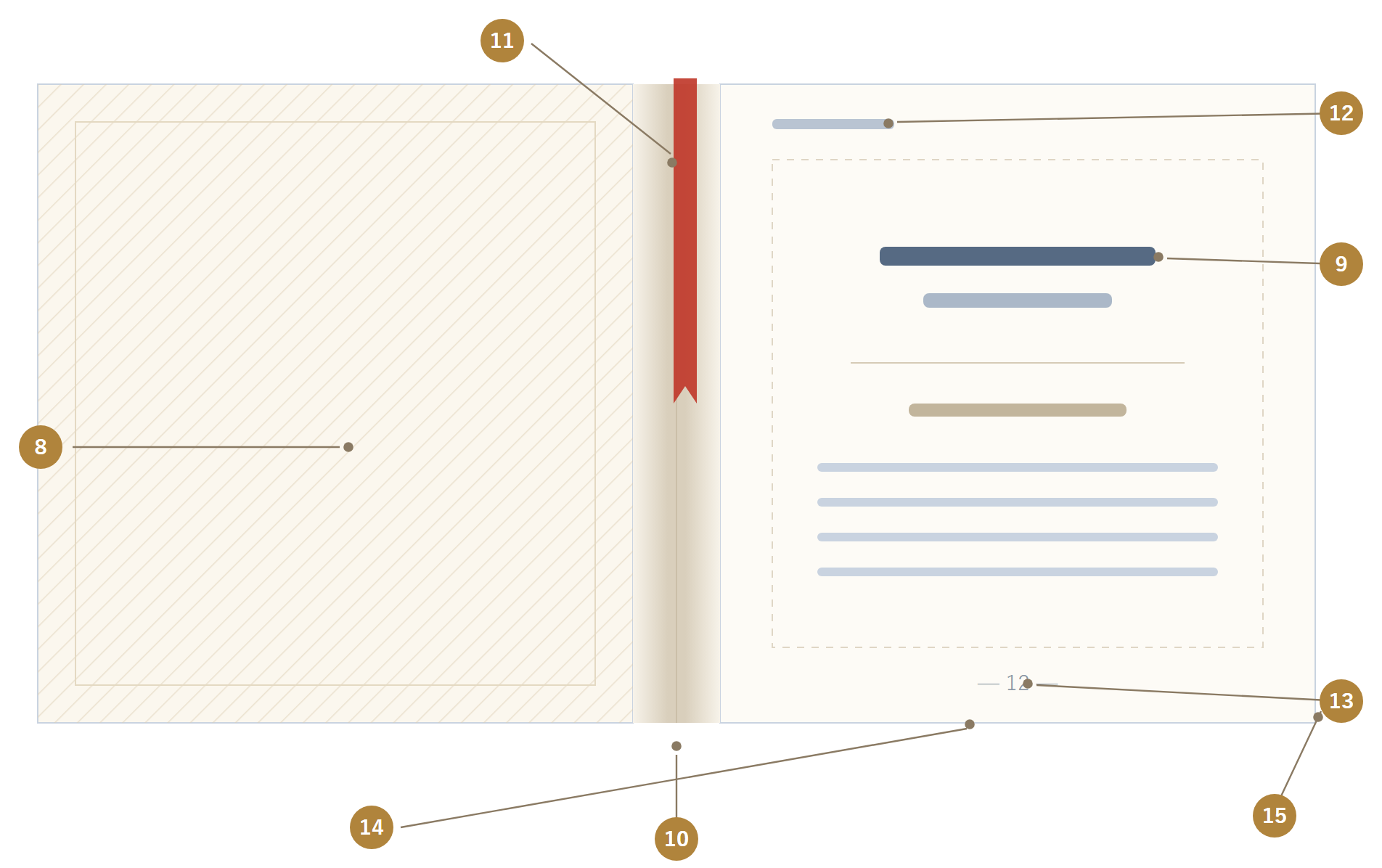
Much of the discussion happens by naming a part. We begin outside, then open the book. The numbers in the diagrams match the lists below.
From the outside
| Part | Japanese | Description |
|---|---|---|
| ① Spine | 背 (se) | The bound edge as the book stands closed. It usually carries title, author and publisher, and is all that shows on a shelf. |
| ② Headband | 花ぎれ | The small woven band at the head and tail of the spine. A finishing step in hardcover work: it hides the join between text block and case, and adds strength. Its colour can be matched to cover or band. |
| ③ Head | 天 (ten) | The top edge of the text block. Head, tail and fore edge are the “three sides”; how evenly they are cut is the first visible measure of quality. |
| ④ Squares | チリ | The width by which the cover projects beyond the text block — about 1.5–3 mm on a hardcover. It protects the edges and gives the book visual breathing room. |
| ⑤ Cover | 表紙 | The outside of the book: boards covered in cloth or paper for a hardcover, heavy paper for a paperback. Printed in four colours plus a finish (gloss or matt). |
| ⑥ Belly band | 帯 (obi) | A paper band wrapped round the lower cover, carrying copy, endorsements or prizes. In Japan it is central to how a book is sold. |
| ⑦ Tail | 地 (chi) | The bottom edge of the text block, and where the folio most often sits. |
From the inside, across a spread
| Part | Japanese | Description |
|---|---|---|
| ⑧ Endpaper free endpaper | 見返し | The sheet pasted inside the cover; every hardcover has one. It may match the text paper or be coloured. With the title page it sets the tone of the book. |
| ⑨ Title page | 扉 (tobira) | The first page of the text, carrying title, subtitle and author in large type. The colophon details are sometimes summarised here as well. |
| ⑩ Gutter | ノド | The inner margin on the bound side. Too narrow and text disappears into the fold and the book will not lie open. It is usually 3–5 mm wider than the fore-edge margin. |
| ⑪ Ribbon marker | しおり | A ribbon glued into the spine, standard in hardcovers, chosen to sit with the text paper and cover. |
| ⑫ Running head | 柱 (hashira) | The book or chapter title set at the top (sometimes the foot) of the page; the two pages of a spread may carry different chapter names. Its position shifts with the setting direction. |
| ⑬ Folio | ノンブル | The page number. Title pages and plates sometimes go without. It may sit high, low or towards the outer edge, but must be consistent throughout. |
| ⑭ Type area | 版面 (hanmen) | The area in which text and figures are actually set; what lies outside it is margin. The type area and leading together decide how much a page holds. |
| ⑮ Fore edge | 小口 (koguchi) | The edge you open the book from. Some books are finished with the title or author printed along it. |
4. Formats and binding methods
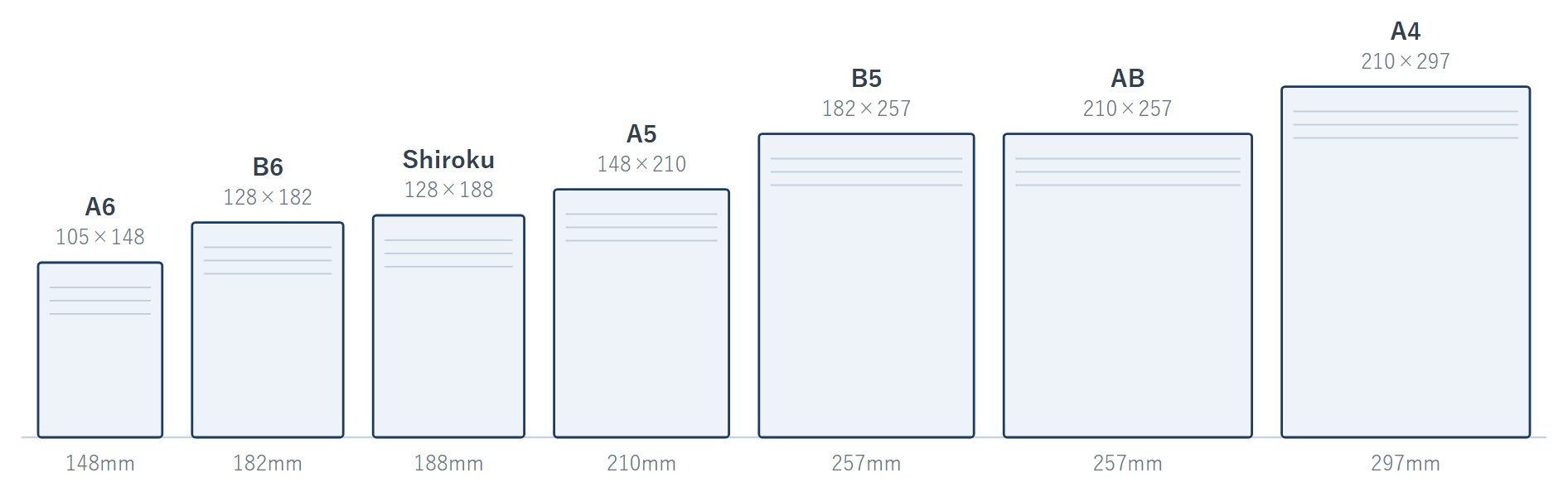
A format is a standard size. Besides the A and B series, Japan makes wide use of its own “Shiroku” size. Change the format and the character count, the extent, the price and the feel in the hand all change with it.
| Format | Size (mm) | Typical use |
|---|---|---|
| A6 | 105 × 148 | Paperback series and new-books; reading matter built for a pocket. |
| B6 | 128 × 182 | Small trade hardbacks; a little more room than a pocket edition. |
| Shiroku | 128 × 188 | The Japanese trade standard: fiction, essays, practical books. |
| A5 | 148 × 210 | Scholarly and practical books; our own standard. Tables and figures fit comfortably. |
| B5 | 182 × 257 | Conference volumes, monographs, textbooks; a lot of information per page. |
| AB | 210 × 257 | Books rich in plates, tables and photographs; landscape figures fit easily. |
| A4 | 210 × 297 | Large plates, source collections, reports. |
Binding methods
| Method | Character | Extent |
|---|---|---|
| Hardcover | Sewn text block, board cover, endpapers, headband. Durable and formal — and the most expensive. | 64–400 pp. |
| Paperback perfect bound | Spine glued. Light, inexpensive, clean in the hand; the majority of trade books today. | 64–300 pp. |
| Saddle stitched | Nested folds wired at the centre. Lies open well, suits thin booklets; too thick and the fore edge steps. | 8–48 pp. |
Estimating the spine. Spine width (mm) ≈ pages ÷ 2 × paper caliper (mm). An A5 book of 128 pages on 70 kg woodfree (about 0.09 mm a sheet) gives 64 × 0.09 ≈ 5.8 mm. You need this figure to build the cover artwork. Because caliper varies with the stock, the final spine width is confirmed once the paper is chosen.
5. Text direction — vertical and horizontal
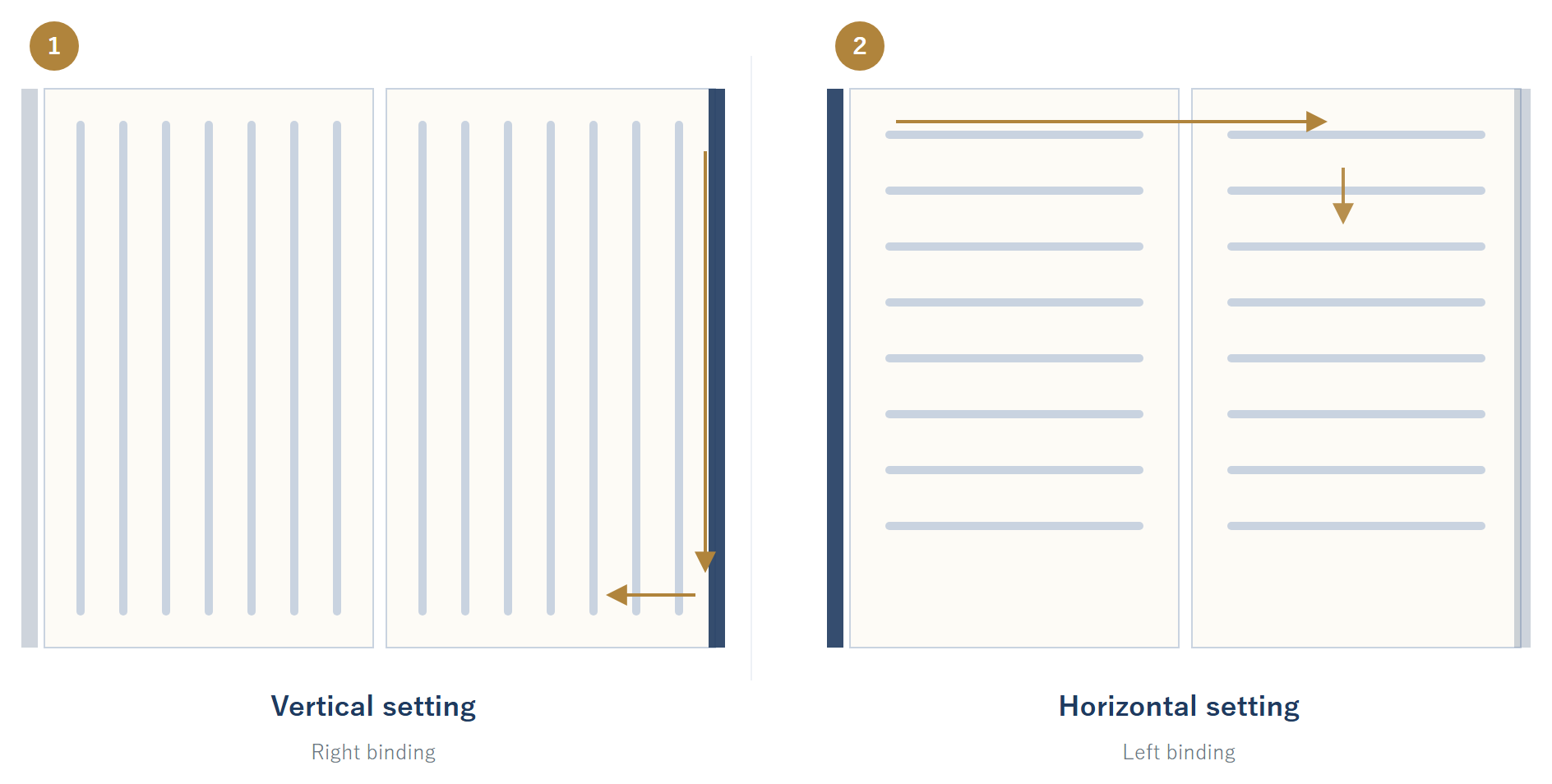
Japanese books are set either vertically or horizontally. Once the direction is fixed, the binding side follows: vertical setting binds on the right, horizontal setting on the left. This is where authors from abroad most often hesitate, so please read the diagram.
| Setting | Binding | Pages turn | Suited to |
|---|---|---|---|
| Vertical | Right | right → left | Fiction, essays, humanities criticism; the traditional Japanese setting. |
| Horizontal | Left | left → right | Scholarly and practical books, books in other languages, books with many tables and figures. |
Which to choose. A book read only in Japanese sits naturally in vertical setting. But a scholarly book that quotes Western sources at length, a book with formulae and tables, or a book written in a language other than Japanese is normally set horizontally. English, French and simplified-Chinese books are horizontal with left binding; traditional-character publishing in Taiwan and Hong Kong sometimes uses vertical setting with right binding. Where Japanese and other languages are mixed, we recommend horizontal setting. Japanese quotations inside a horizontal page are no problem at all.
If you choose vertical setting. Plates, tables, formulae, URLs and long quotations in Western languages are either rotated 90° on the page or given a horizontal page of their own. Ruby (furigana) can be set in either direction; a manuscript in a European language needs none. Because running heads, folios and plate positions all move with the setting direction, the cover and title page are adjusted once the text pages are settled.
6. Standard specification and file delivery
The following is an example of our standard specification. Format, paper, binding and the number of printing colours are proposed individually to match your budget and the purpose of the book.
- Format: A5 (148 × 210 mm; can be changed to suit your wishes)
- Extent: about 128 pages (adjusted to the length of the manuscript)
- Setting: horizontal, bound left (vertical, bound right, is available for Japanese fiction)
- Printing: text in one colour; cover in four colours with a gloss or matt finish
- Paper: 70 kg woodfree for the text, 180 kg art paper for the cover
- Binding: perfect-bound paperback with a jacket (hardcover also available)
- Illustrations and tables: tables can be included; plates are quoted separately depending on their content
- ISBN and colophon: obtained and prepared by us
Checklist for delivering files
- Print-ready PDF, fonts embedded, layers flattened
- Trim size plus 3 mm bleed, with trim marks at the four corners
- Images at 350 dpi, CMYK — supplied as RGB, the colour will shift
- Text and cover as separate files; spine width confirmed once the paper is chosen
- Copy for the title page, contents and colophon (please check the form of your name and the title one last time)
- Corrections in red, with the page and line clearly identified
Print-ready data is handed to the author when the book is finished, so it can also be used for reprints you arrange yourself later. For advice on format, paper or binding, or for a quotation, please speak to the editor handling your project (llj@jpxcn.com).
* The terms and specifications on this page follow ordinary Japanese publishing practice. Names and standard dimensions differ from country to country; please ask us if anything is unclear.